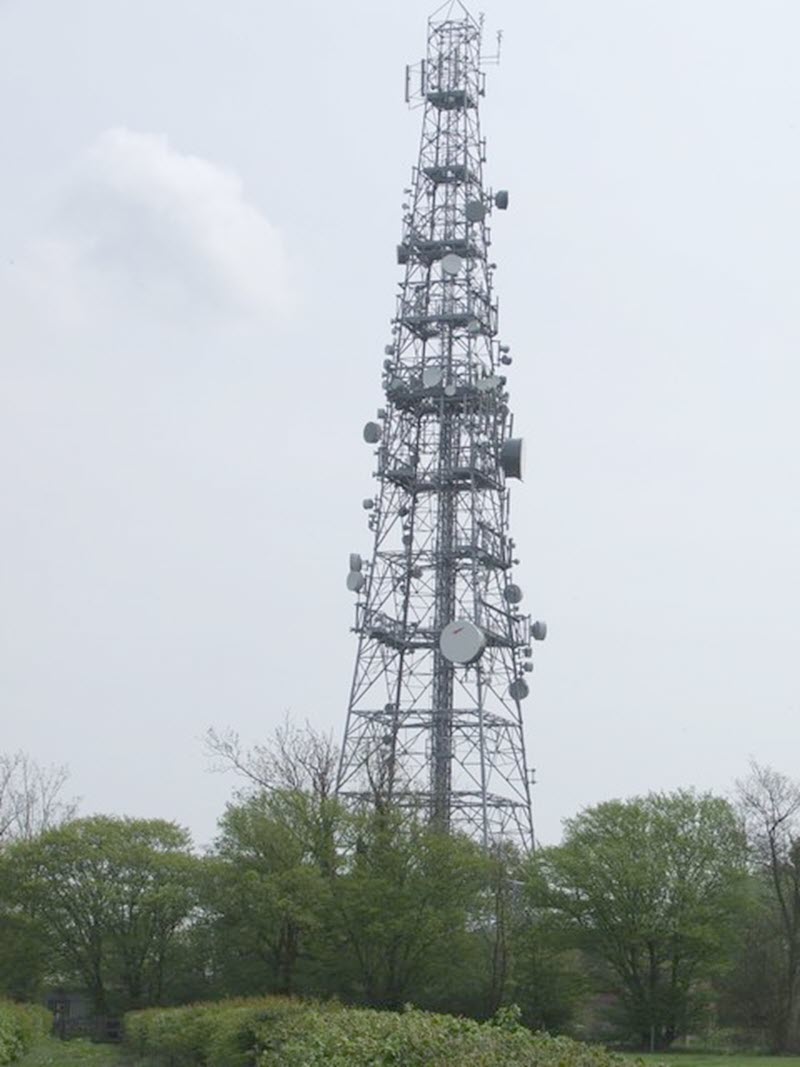
History
Hertford Heath was the subject of planning applications in 1985 and 1986, revised and approved in 1987. This was a "takeover" site originally operated by Eastern Gas as part of the national network of microwave links. BT would construct a new building and tower of similar height but with greater capacity to carry large dish antennas. A sketch map included with the first planning submission shows the site was intended to provide an additional path between Sibleys and what was then known as the London Telecom Tower (LTT). This would allow increased capacity on the routes to Leeds and Norwich which merged at Sibleys with a shared section via Kelvedon Hatch.
The initial plan was for a modular "Type 8A" tower, used at many of the 1980s sites, however this was changed to a "pylon" design. The building is a non-standard design, featuring a high roof covered with brown tiles and "dark red facing brickwork with coloured mortar". Perhaps this was to satisfy local planning requirements. The plans show nine large dishes facing London, to be installed over a number of years. The initial arrangement would have just two dishes facing each way. BT would occupy the tower between approximately 24 m and 47 m above ground level, the gas network would use the top section of the 64 m structure. We understand the approach to the site is over a poor-quality track - originally part of the Roman Ermine Street but bypassed by later versions of the A10/Great Cambridge Road.
It's not known whether the site developed as originally planned but the earliest avilable photograph (2008) suggests any dishes for the trunk network had already been removed. The site continues to be operated by BT and appears to provide a number of local SHF links together with mobile phone coverage for the local area.